


White Cedar Ancient Wisdom for Modern Rituals
When you hold a sprig of White Cedar (Thuja occidentalis) in your hands, you're connecting with a botanical legacy that spans thousands of years. At Sacred Plant Co, we honor both the plant and the soil ecosystem that sustains it. Every sprig you receive has been wildcrafted with intention, dried slowly to preserve volatile oils, and handled with the care befitting an herb known for centuries as the "Tree of Life."
White Cedar's Latin name, Thuja occidentalis, translates to "western arbor vitae," a name bestowed by French explorer Jacques Cartier in 1535 after Indigenous healers saved his crew from scurvy using cedar tea.1 The resinous, evergreen branches carry a scent profile that marries crisp pine with cool camphor and subtle green apple notes, a complexity born from thujone, pinene, and other aromatic compounds that have made this plant central to aromatic and ceremonial practices across North America.
Historical & Cultural Context: A Plant of Protection and Purification
For Indigenous communities of the Great Lakes region and northeastern woodlands, White Cedar holds sacred status. The Ojibwe people call it "Nookomis Giizhik" or "Grandmother Cedar," honoring its role as one of the four medicines in traditional smoke-cleansing ceremonies alongside sage, sweetgrass, and tobacco.2 Cedar smoke was understood to carry prayers upward, create protective boundaries, and cleanse spaces of stagnant energy.
In Lakota sun dance ceremonies, cedar is offered to fire for purification, and cedar branches are laid on sweat lodge floors as spiritual protection.3 The smoke was believed to strengthen clairvoyance, revitalize tired spirits, and guard against illness—applications that reflect cedar's dual nature as both grounding and elevating.
Historically, some communities prepared very mild cedar infusions from the inner bark and young twigs, particularly during winter months when vitamin C sources were scarce. These preparations were part of survival medicine and required extensive traditional knowledge to prepare safely.
However, it's critical to understand: White Cedar contains thujone—a monoterpene ketone that can be neurotoxic when consumed internally in significant amounts.4 Any internal preparation requires extreme caution and professional herbal guidance. The historical uses of cedar tea were contextual, rare, and practiced by people with generations of plant knowledge. Modern safety standards recognize that thujone-containing plants should not be consumed casually.
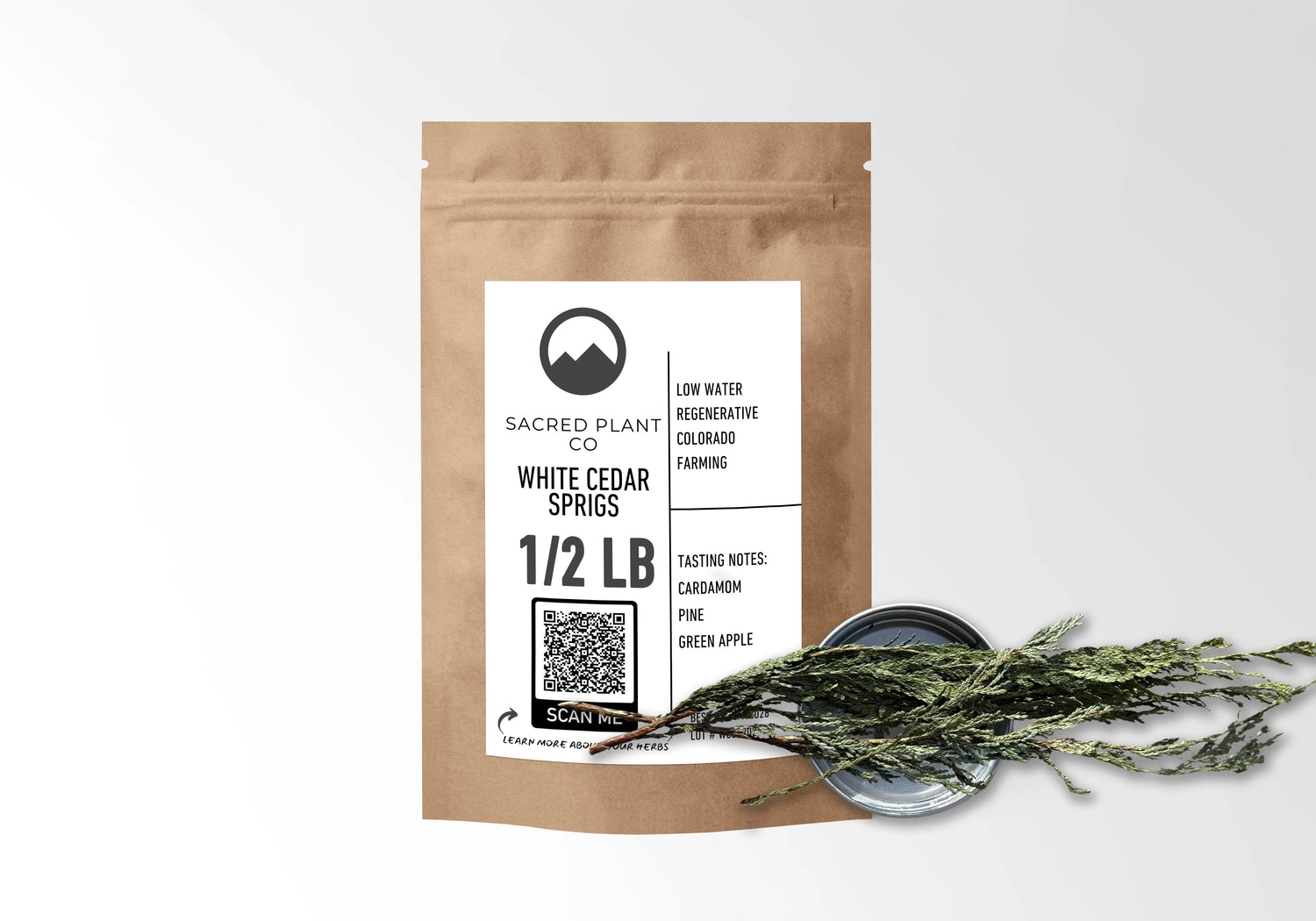
White Cedar Sprigs
Starting at $17.17
Premium wildcrafted White Cedar (Thuja occidentalis) sprigs traditionally used for smudging, cleansing ceremonies, and aromatic space clearing. Sustainably harvested evergreen with crisp resinous scent.
Learn More⚠️ Critical Safety Information
Thuja occidentalis contains thujone, a compound that is neurotoxic when consumed internally. Studies show thujone can cause convulsions, tremors, and other serious adverse effects at relatively low doses.5,6 Historical internal uses of cedar were rare, mild, and limited to trained practitioners within specific cultural contexts.
Sacred Plant Co offers White Cedar for external aromatic and ritual use only. We do not recommend internal consumption. If you are curious about traditional cedar preparations for educational purposes, consult a qualified clinical herbalist or naturopathic physician who specializes in traditional botanical medicine.
Aromatic & Sensory Profile: The Scent of Winter Forests
White Cedar's aromatic signature is immediately recognizable: imagine walking through a snow-dusted evergreen forest where the air is sharp with resin and clean with frost. The primary scent notes include:
- Crisp Pine: The dominant aromatic, reminiscent of fresh-cut evergreen boughs
- Cool Camphor: A mentholated edge that opens the sinuses and sharpens focus
- Green Apple & Cardamom: Subtle fruity-spice undertones that emerge as the plant smolders
- Woody Resin: A grounding base note that lingers after the smoke clears
When burned, cedar releases these aromatic compounds slowly. The smoke is thicker than sage, more resinous than lavender, and carries a presence that feels both protective and clarifying. Crushing fresh sprigs between your fingers releases a burst of volatile oils—pinene, thujone, and fenchone—that create an instant sensory connection to the plant's vitality.
Hung in bundles, cedar maintains its scent for months, slowly releasing aromatic molecules into the surrounding air. This makes it ideal for aromatic sachets, wreaths, and long-term space clearing without combustion.
How People Use White Cedar: External Applications & Ceremonial Context
White Cedar's primary modern applications are external and aromatic. Here are the most common ways people work with this botanical:
Smoke Rituals & Space Clearing
Burning cedar sprigs creates thick, fragrant smoke traditionally used for cleansing spaces, objects, and individuals. Many practitioners use cedar at threshold moments—moving into a new home, after conflict, during seasonal transitions—to mark energetic boundaries and invite fresh perspective.7
Aromatic Bowls & Non-Combustion Use
Cedar sprigs can be placed in bowls throughout living spaces, releasing subtle aromatic notes without smoke. This method is ideal for those sensitive to combustion or in environments where burning isn't practical.
Hanging Bundles & Wreaths
Cedar's natural insect-repelling properties and long-lasting scent make it perfect for hanging in closets, entryways, or bedrooms. The oils continue to evaporate slowly, providing months of aromatic benefit.
Crafts & Seasonal Décor
Cedar's flexible branches and evergreen foliage make it a favored material for wreaths, garlands, and natural decorations that bring forest energy indoors.
Explore Related Aromatic Practices:
How to Use Sacred Plant Co's White Cedar: Step-by-Step Burning Method
If you choose to burn your White Cedar sprigs, follow this protocol for safety and optimal aromatic release:
Step 1: Prepare Your Space
Open windows or doors to ensure proper ventilation. Place a heat-proof bowl or abalone shell beneath the cedar to catch falling embers and ash.
Step 2: Light the Cedar
Hold the cedar sprig at an angle and light the tip using a match or lighter. Allow the flame to catch for 10-15 seconds, then gently blow it out. The cedar should smolder, producing fragrant smoke rather than open flame.
Step 3: Direct the Smoke
Use your hand or a feather to waft smoke toward yourself or around your space. Move slowly, allowing the smoke to reach corners, doorways, and areas where energy feels stagnant.
Step 4: Extinguish Completely
When finished, press the smoldering end firmly into sand or soil in your heat-proof container. Never leave burning cedar unattended. Ensure all embers are fully extinguished before storing.
Why these steps matter: Proper ventilation prevents smoke accumulation. Controlled smoldering (rather than open flame) preserves aromatic compounds and reduces harsh combustion byproducts. Complete extinguishing prevents fire hazards and preserves remaining plant material.
Storage & Longevity: Preserving Aromatic Potency
White Cedar maintains its aromatic integrity for 12-18 months when stored properly:
- Keep Dry: Store in a sealed container or kraft bag away from moisture
- Avoid Direct Sunlight: UV light degrades volatile oils over time
- Cool Environment: Room temperature or cooler preserves terpene content
- Check Periodically: Cedar should remain pliable and aromatic; brittleness indicates oil loss
What Makes Sacred Plant Co's White Cedar Premium
We source our White Cedar from wildcrafted stands in northern climates where cold winters and rocky soil produce plants with concentrated aromatic profiles. Our regenerative approach means:
- Selective Harvesting: We take only mature sprigs, leaving young growth to mature
- Slow Air-Drying: No kiln drying or heat processing that degrades essential oils
- Whole Sprig Integrity: We keep branches intact to preserve structural aromatics
- Small-Batch Processing: Each batch is handled individually, ensuring quality control
- Eco-Friendly Packaging: Kraft bags that breathe while protecting contents
Tasting Notes on Package: Cardamom, Pine, Green Apple
These notes reflect the complexity of our cedar's aromatic profile—a signature of plants grown in high-quality soil with minimal human intervention.
Certificate of Analysis & Quality Assurance
At Sacred Plant Co, transparency is non-negotiable. Every batch of White Cedar is accompanied by a Certificate of Analysis (COA) that verifies:
- Botanical identity confirmation (Thuja occidentalis)
- Microbial safety testing
- Heavy metal screening
- Moisture content analysis
Request your batch-specific COA by contacting us with your product lot number. This commitment to testing ensures you receive cedar that is pure, potent, and safe for aromatic use.
Frequently Asked Questions
What is White Cedar traditionally used for?
White Cedar has been used for centuries in smoke-cleansing ceremonies, aromatic space clearing, and as a protective herb in Indigenous traditions. Externally, it's valued for its resinous, purifying smoke. Historically, some cultures prepared very mild internal preparations, but modern safety standards recognize the risks of thujone toxicity from internal use.
What does White Cedar smell like?
White Cedar has a complex aromatic profile: dominant notes of crisp pine and cool camphor, with subtle undertones of green apple, cardamom, and woody resin. When burned, it produces thick, fragrant smoke that's more resinous than sage.
How do I burn White Cedar safely?
Light the tip of a cedar sprig, allow it to catch for 10-15 seconds, then blow out the flame to create smoldering smoke. Use in a well-ventilated space with a heat-proof container beneath. Extinguish completely by pressing into sand or soil when finished.
How long does White Cedar last?
When stored properly (dry, sealed, away from sunlight), White Cedar maintains its aromatic potency for 12-18 months. The sprigs should remain pliable and fragrant; brittleness indicates oil degradation.
Can I drink cedar tea?
Historically, some Indigenous communities prepared very mild cedar infusions in rare contexts, but this required extensive traditional knowledge. White Cedar contains thujone, which is neurotoxic internally. Modern herbalism does not recommend internal cedar preparations without professional supervision. Sacred Plant Co offers cedar for external aromatic use only.
Why does Sacred Plant Co offer White Cedar only for external use?
Thuja occidentalis contains thujone, a compound that can cause serious neurotoxic effects when consumed internally, including convulsions and tremors. While historical uses existed in specific cultural contexts with proper training, modern safety standards require professional herbal guidance for any internal preparation. We prioritize your safety by offering cedar for its traditional external aromatic applications.
Is White Cedar the same as Red Cedar?
No. White Cedar (Thuja occidentalis) is distinct from Western Red Cedar (Thuja plicata) and Eastern Red Cedar (Juniperus virginiana, which is actually a juniper). Each has different aromatic profiles and traditional uses.
References
- CedarWorks. (2022). "Did you know Northern White Cedar is a cure for scurvy? Random facts about our favorite tree." Retrieved from https://www.cedarworks.com/blog/view/did-you-know-northern-white-cedar-is-a-cure-for-scurvy-random-facts-about-our-favorite-tree
- University of Vermont Center for Teaching and Learning. "UVM Tree Profiles: Northern White Cedar - Ceremonial Uses." Retrieved from https://libraryexhibits.uvm.edu/omeka/exhibits/show/uvmtrees/northernwhitecedar/ceremonial-uses
- The Sacred Science. (2023). "The Art Of Smudging - A Shamanic Cleansing Ritual." Retrieved from https://www.thesacredscience.com/the-art-of-smudging/
- Pelkonen, O., Abass, K., & Wiesner, J. (2013). "Thujone and thujone-containing herbal medicinal and botanical products: toxicological assessment." Regulatory Toxicology and Pharmacology, 65(1), 100-107. PMID: 23201408
- Randjelović, P. J., Stojanović-Radić, Z. Z., et al. (2017). "Toxic essential oils. Part V: Behaviour modulating and toxic properties of thujones and thujone-containing essential oils." Food and Chemical Toxicology, 105, 355-369. PMID: 28472675
- ScienceDirect Topics. "Thuja occidentalis - an overview." Retrieved from https://www.sciencedirect.com/topics/medicine-and-dentistry/thuja-occidentalis
- Sacred Plant Co. "Apothecary Ritual Herbs: The Forgotten Science of Sacred Plant Practice." Retrieved from https://sacredplantco.com/blogs/natures-pharmacy-exploring-the-historical-uses-and-health-benefits-of-medicinal-herbs/apothecary-ritual-herbs-the-forgotten-science-of-sacred-plant-practice
Disclaimer: This information is for educational purposes only and has not been evaluated by the FDA. This product is not intended to diagnose, treat, cure, or prevent any disease. White Cedar is offered for external aromatic use only. Consult a qualified healthcare practitioner before using botanicals, especially if you are pregnant, nursing, taking medications, or have a medical condition.


