


Last Updated: May 19, 2026
Mullein Leaf: A Traditional Powerhouse
 The distinctive felt-like texture of a first-year mullein rosette provides a visual confirmation of the plant's robust defense mechanisms and high verbascoside potential.
The reason mullein leaf has carried a reputation for soothing irritated airways across continents for more than two thousand years comes down to a small group of molecules. Verbascoside, a phenylethanoid glycoside, sits alongside long-chain mucilage polysaccharides and triterpene saponins in the velvety leaf of Verbascum thapsus, and together these compounds form the chemical signature behind every cup of mullein tea, every steaming bowl, every gentle smoking blend recorded in the historical record.1
Here is the part most modern herb shoppers never hear. These compounds are not freebies. Verbascoside and the mullein saponins are defense molecules the plant builds in response to microbial pressure, UV stress, and biological signaling in living soil. Sterilized commodity fields produce paler, less concentrated leaf. Living soil produces the chemistry you actually want in your cup. This is chemistry created by struggle, not comfort, and it is the lens through which we approach every herb at Sacred Plant Co.
If you want to see the numbers behind that thesis, our published Haney Score data documents the soil biology behind our regenerative beds.
What You'll Learn
- The exact compounds in mullein leaf (verbascoside, saponins, mucilage) and why each one matters
- How to identify high-quality dried mullein by color, texture, and aroma
- Step-by-step instructions for brewing a smooth, throat-friendly mullein infusion
- Traditional uses across Native American, European, Ayurvedic, and Chinese herbal systems
- Safe dosing ranges and who should consult a professional first
- A soothing three-herb bedtime tea recipe with mullein, chamomile, and lavender
- How to read our third-party Certificate of Analysis for transparency
- Where mullein fits inside Sacred Plant Co's regenerative apothecary
Key Takeaways
- Mullein leaf (Verbascum thapsus) is a biennial herb in the Scrophulariaceae family, traditionally used in European, Native American, and Eurasian folk practice for respiratory comfort and gentle topical preparations.
- The principal active compounds in mullein leaf are verbascoside (a phenylethanoid glycoside), mucilage polysaccharides, flavonoids, and triterpene saponins, each documented in modern phytochemical literature.
- A standard household mullein infusion uses 1 to 2 teaspoons of cut and sifted leaf per 8 oz of hot water, steeped 10 to 15 minutes, and strained through fine mesh to remove leaf hairs.
- Sacred Plant Co's regenerative beds have tested at a Haney Score of 25.4, exceeding pristine forest benchmarks and demonstrating measurable soil biology behind our herbs.
- The botanical genus Verbascum contains roughly 360 accepted species, of which Verbascum thapsus is the most widely recorded in Western herbal tradition.
- Mullein leaf is caffeine-free and is most commonly prepared as a tea, steam inhalation, or component of traditional herbal smoking blends.
| Latin Name | Verbascum thapsus |
|---|---|
| Family | Scrophulariaceae |
| Common Names | Great Mullein, Velvet Dock, Candlewick Plant, Hag's Taper |
| Parts Used | Dried leaf (primary), flowers, occasionally root |
| Primary Active Compounds | Verbascoside, mucilage polysaccharides, flavonoids, triterpene saponins, iridoids |
| Plant Type | Biennial herb, basal rosette in year one, tall flowering stalk in year two |
| Traditional Energetics | Cool, moistening, demulcent (Western); balances Kapha and Vata (Ayurveda); nourishes Yin (TCM) |
| Typical Household Dose | 1 to 2 tsp dried leaf per 8 oz hot water, 1 to 3 cups per day |
| Caffeine Status | Caffeine-Free |
| Sacred Plant Co COA | View Lot MULL-4535 PDF |
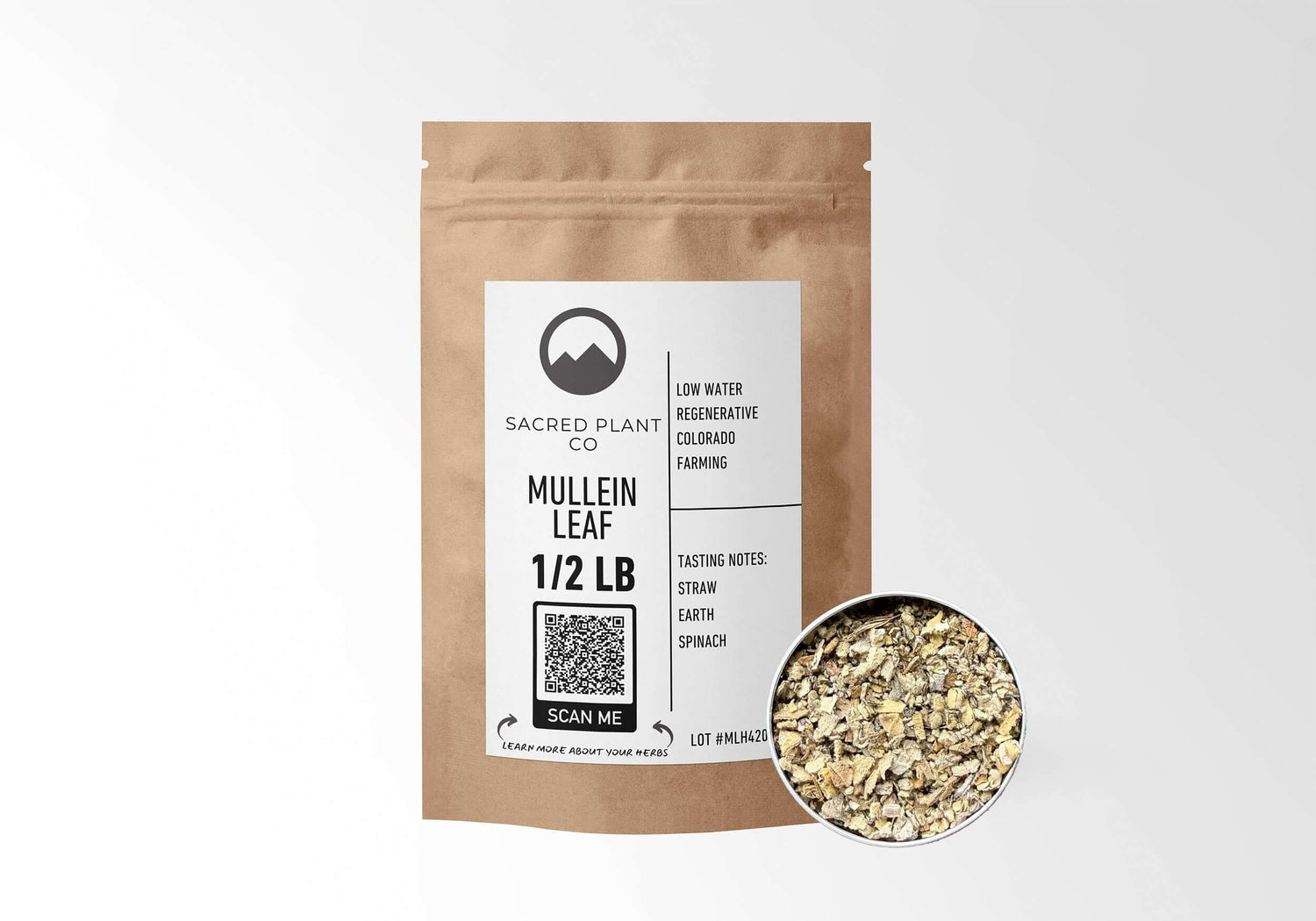
Mullein Leaf, Cut & Sifted
Starting at $12.07
Caffeine-FreeSoft, fuzzy, traditionally-used Verbascum thapsus leaf, sourced under our Beyond Organic regenerative standard and third-party lab tested for purity.
Explore MulleinWhat Is Mullein Leaf?
Mullein leaf is the dried foliage of a tall, soft-leafed biennial that has anchored European and North American folk herbalism for over two thousand years. It is a plant with a long visual signature: low rosettes of grey-green velvet in its first year, then a candlestick-like flowering stalk in its second.
The genus Verbascum contains roughly 360 accepted species across Eurasia, with Verbascum thapsus standing as the species most frequently cited in Western herbals.2 This is the leaf you will find in nearly every classical respiratory herbal formula written in English, German, or French between the 1500s and the early 1900s.
Native American Reverence for Mullein
Several Native American tribes considered mullein a meaningful plant ally, integrating it into both household and ceremonial practice. Historical ethnobotanical surveys, including those compiled by Daniel Moerman, document mullein appearing in the records of Cherokee, Navajo, Iroquois, and Mohegan communities, often in connection with respiratory comfort and topical poultices.3 The leaves, with their soft mucilaginous texture, were folded into teas and poultices that traveled with the seasonal cycles of the household.
Traditional Medicinal Uses
 A properly steeped hot water infusion ensures the extraction of long-chain mucilage polysaccharides, delivering the soothing properties mullein is known for.
The most widely recorded traditional use of mullein leaf is in support of respiratory comfort. The leaves were often brewed into teas or layered into poultices to ease coughs and bronchial discomfort. The mucilaginous nature of mullein leaves was understood to coat and soothe irritated mucous membranes, creating a protective film over inflamed tissues. In modern phytochemistry this corresponds to the long-chain polysaccharide fraction that swells in hot water, giving mullein tea its characteristic slightly silky mouthfeel.4
Native healers also crafted poultices from mullein leaves to apply directly to the chest. The warmth and moisture of the poultice were thought to enhance the herb's effects, and the practice persisted into Appalachian and Ozark folk medicine well into the 20th century.
Smoking Blends
 Because of its soft, non-irritating smoke profile, dried mullein has historically functioned as an ideal foundational base herb in traditional non-tobacco botanical blends.
Another widely recorded use of mullein leaves was in herbal smoking blends. Native healers, and later European folk herbalists, often included dried mullein in these blends because the smoke is notably mild and less irritating than tobacco smoke. The practice is reflected in many published smoking herb formulas of the 1800s and is still common in modern non-tobacco blends.5 For a deeper look at how different cultures shaped the ceremony and intention behind these blends, our piece on the rituals behind smokable herbs walks through the cultural origins and responsible-use framework that pairs naturally with mullein's role here.
Spiritual Significance
Beyond physical wellness, mullein held meaningful spiritual value in several cultural contexts. The plant was believed in folk tradition to possess protective qualities, capable of warding off harmful energies and safeguarding the home. Mullein leaves were sometimes carried as amulets or placed around living spaces to create a barrier against negativity. The spiritual reverence for mullein extended to its use in ceremonies, where dried leaves were burned as a gentle smudge or carried alongside other protective plants.
Integration into Daily Life
The integration of mullein into daily life across many cultures underscores the plant's versatility. It was simultaneously a household remedy, a candle component, a smoking herb, and a protective talisman. This multifaceted use reflects the holistic approach to wellness practiced by traditional cultures, where the physical, mental, and energetic aspects of life are understood as interconnected.
How to Identify Premium Mullein Leaf
Premium dried mullein leaf is soft to the touch, light grey-green to olive in color, finely cut to minimize stems, and carries a mild, slightly sweet, hay-like aroma. The sensory profile is subtle. Mullein is not a loud herb. Its quality reveals itself in texture and freshness rather than in dramatic flavor.
Color
Look for a soft, dusty grey-green tone, sometimes with hints of pale olive. Brown, brittle, or dust-heavy leaf is a sign of old stock or poor drying.
Texture
Top-grade mullein retains the velvety quality of the living leaf, even in a cut and sifted form. Run a pinch between your fingers. It should feel soft and almost felted, not dry-papery or coarse. Excessive stem is a quality red flag.
Aroma
A fresh mullein leaf has a quiet, slightly herbaceous, almost hay-like fragrance. If a sample smells musty, sour, or smoke-tinged from poor drying, set it aside.
Tasting Notes
Mild, earthy, lightly green, with a soft silky mouthfeel from the natural mucilage. This is a tea that rewards a longer steep and benefits from being blended with peppermint, lemon balm, licorice root, or honey for a fuller cup.
If you would like a deeper rundown on storage so your herbs hold this quality, our guide to buying, storing, and using bulk herbs walks through the moisture, light, and container rules that protect verbascoside content over time.
Mullein in European Tradition
 Covered-bowl steam inhalation captures the volatile aromatic components and moistening qualities of the leaf, carrying them directly to the mucous membranes.
In European tradition, mullein has been called the Candlewick Plant, the Hag's Taper, and the Velvet Dock, reflecting both its physical structure and its dual role as a household plant and a folk medicine. Across the Atlantic, the tall, sturdy stalks of mullein were often dipped in grease or wax and set alight to serve as torches during processions and rituals.
Practical Uses
The practical applications of mullein extended beyond torches. The plant's soft, downy leaves were used as wicks for oil lamps and as a kind of natural insulating material in clothing. This utility helped spread mullein's reputation across Europe and contributed to its naturalization across nearly every temperate region of the world.
Herbal Medicine
In wellness terms, mullein was highly valued in European herbal medicine for respiratory and skin comfort. Herbalists prepared mullein leaf infusions, teas, steams, and poultices for a range of household uses.
- Respiratory Comfort: Mullein's soft, mucilaginous, mildly demulcent character made it a common remedy for irritated throats, dry coughs, and seasonal congestion. Herbalists brewed infusions from the leaves and used the steam from a covered pot as a gentle inhalation.
- Skin Care: Mullein leaves were also applied externally in poultices and oil infusions to support the look and feel of irritated or rough skin. The mucilage and the saponin fraction combined to make a soothing, slightly emollient topical preparation.
Symbolic and Cultural Significance
The symbolic use of mullein in rituals extended to its cultural significance in folklore. In some regions, mullein was believed to possess protective qualities. Bundles were sometimes hung over doorways to ward off harmful influences, or placed in fields to protect crops from pests. Known as Hag's Taper, mullein was woven into European witchcraft and folk magic, where the dried leaves and flowers were included in protective sachets and amulets for the home and its inhabitants.
Ayurvedic and Traditional Chinese Medicine Perspectives
In Ayurveda, mullein is viewed as warming and demulcent, helpful for balancing Kapha and Vata; in Traditional Chinese Medicine, it is appreciated for nourishing Yin energy and moistening the Lung organ system. Although mullein is native to Europe and western Asia, herbalists trained in Ayurvedic and Chinese frameworks have integrated it into modern practice by mapping it onto their own energetic systems.
Ayurvedic Perspective
- Kapha Dosha: Mullein's warming nature is understood to help balance Kapha by encouraging movement of damp, congested patterns and clearing excess mucus.
- Vata Dosha: Mullein's soothing, slightly moistening quality is understood to counteract Vata's dry, mobile tendency, particularly in the upper respiratory tract.
- Respiratory Support: Modern Ayurvedic practitioners often use mullein in teas and infused oils as a complement to classical respiratory herbs such as vasa, licorice, and tulsi.
Traditional Chinese Medicine Perspective
- Yin Energy: In TCM language, Yin represents coolness, moisture, and stillness. Mullein's ability to moisten and soothe maps neatly onto the Yin-nourishing category.
- Lung Channel: TCM practitioners include mullein in modern Western-trained TCM formulas aimed at supporting Lung Yin during dry seasonal transitions.
- Mental and Emotional Tone: By nourishing Yin energy, mullein is sometimes paired with calming Yin herbs in tea formulas designed for late-day restoration.
If you want to see the wider TCM and Western framework for clearing mucus, our piece on herbs for phlegm in TCM and Western herbalism walks through how mullein sits inside that larger cross-system map. For a head-to-head look at where mullein and lobelia overlap and where they diverge, our Mullein vs. Lobelia comparison provides the side-by-side detail.
The Phytochemistry of Mullein Leaf
Modern phytochemical analyses of Verbascum thapsus have identified verbascoside, mucilage polysaccharides, flavonoids (notably apigenin and luteolin glycosides), iridoid glycosides, and triterpene saponins as the primary constituents of the dried leaf. Each one contributes a distinct quality to the herb's traditional use profile.
- Verbascoside: A phenylethanoid glycoside studied for antioxidant and anti-inflammatory activity in laboratory and cellular models.6
- Mucilage Polysaccharides: Long-chain sugars that swell in hot water, providing the silky mouthfeel and the traditional demulcent quality.
- Flavonoids: Including luteolin and apigenin derivatives, both of which appear repeatedly in the medicinal plant literature for their antioxidant profile.
- Saponins and Iridoids: Triterpene saponins, including verbascosaponin, are reported in the leaf and contribute to the herb's expectorant reputation in folk usage.
What ties these compounds back to soil is straightforward. The biosynthesis of secondary metabolites in medicinal plants is widely reported in the agronomic literature as being shaped by soil microbial communities, nutrient cycling, and stress signals. This is exactly why we operate under the Beyond Organic standard, which exceeds USDA certification by measuring living soil biology rather than the mere absence of synthetic inputs.
Preparation Methods and Ritual
The most common preparation of mullein leaf is a simple infusion: 1 to 2 teaspoons of dried cut-and-sifted leaf per 8 oz of hot water, steeped 10 to 15 minutes, and strained through a fine mesh or cheesecloth to remove the tiny leaf hairs. The straining step is the one most often skipped. The leaf trichomes can tickle the throat, and a tight strain makes the cup noticeably smoother.
Steam Inhalation
Mullein has been used in folk practice for centuries as a steam herb. A small handful of dried leaf placed into a bowl of just-boiled water, covered with a towel, then inhaled at a safe distance, is the classic format. Caution with heat is essential, and the practice is not a substitute for medical care.
Smoking Blends
Where mullein appears in non-tobacco smoking blends, it is typically a base herb because of its mild, less irritating smoke. Our ultimate guide to the best herbs for smoking walks through these blends in detail for readers exploring traditional formats.
Ritual and Preparation
At Sacred Plant Co we treat the moment of preparation as part of the medicine. We measure with intention, pour with attention, and let the cup steep without rushing it. The phrase Sacred Plant Co exists because we believe in the relationship between the person, the plant, and the cup. Tea is not just liquid. It is a small daily ritual.
Mullein Soothing Herbal Tea
- 1 tablespoon of dried Mullein leaves
- 1 teaspoon of dried Chamomile flowers
- 1 teaspoon of dried Lavender flowers
- 2 cups of boiling water
- Honey or agave nectar to taste
Combine the mullein leaves, chamomile, and lavender in a teapot or mason jar. Pour over the boiling water and let it steep for about 10 to 15 minutes. Strain very well through fine mesh, then add honey or agave nectar to taste. Sip this calming brew before bed or when you need a moment of tranquility.
Safety Considerations
Mullein leaf is generally considered well-tolerated in traditional use, with the main practical concern being thorough straining of the tiny leaf hairs that can irritate the throat if not removed. Like any herb, mullein deserves a balanced look at both modern medical contraindications and traditional energetic considerations.
Medical Contraindications
Pregnant or nursing individuals, children, and anyone managing ongoing medical conditions or taking prescription medications should consult a licensed healthcare provider before adding any herb to their routine, including mullein. The fine leaf hairs can irritate the throat if not strained thoroughly. Rarely, some people report mild skin sensitivity when handling fresh leaf.
Traditional Energetic Considerations
In Western folk energetics, mullein is considered cool and moistening, which is why it pairs well with warming aromatics such as peppermint or thyme rather than other cool, damp herbs. In Ayurveda, persons with strong Kapha imbalance may prefer pairing mullein with drying or warming herbs to balance the moistening effect.
This information is educational and reflects historical and household use patterns. It is not meant to diagnose, treat, cure, or prevent any disease.
Dosage Guidelines
A typical household dose of dried mullein leaf is 1 to 2 teaspoons per 8 oz of hot water, with 1 to 3 cups per day during seasonal changes representing a common culinary-herbal pattern.
- Tea Infusion: 1 to 2 teaspoons of dried leaf per 8 oz of hot water, steeped 10 to 15 minutes, well-strained. 1 to 3 cups per day.
- Longer Infusion: 1 tablespoon of dried leaf per 16 oz of just-off-the-boil water, covered, steeped 30 to 60 minutes for a richer mucilage extraction.
- Steam: A small handful of dried leaf in 4 to 6 cups of just-boiled water, covered, inhaled at a safe distance for 5 to 10 minutes.
- Smoking Blends: Used as a base, mullein is typically 30 to 60 percent of a non-tobacco blend by volume.
Everyone is different. Start modestly, observe how you respond, and adjust. This information is educational and not a substitute for personalized medical advice.
Certificate of Analysis
Every lot of Sacred Plant Co mullein leaf is third-party lab tested for purity, potency, and contaminants. Lot MULL-4535 cut and sifted wild-crafted mullein leaf has a current Certificate of Analysis available below.
View Lab Report (Lot MULL-4535)
For a walk-through of what each row on a COA actually means, our guide on how to read a Certificate of Analysis explains heavy metals testing, microbial limits, and what we accept or reject.
Mullein Leaf Frequently Asked Questions
What is mullein leaf and how is it traditionally used?
How do I make a simple mullein tea?
What does mullein tea taste like?
How much mullein tea should I drink per day?
Is mullein safe? Are there any side effects?
Who should avoid mullein or consult a professional first?
Can mullein be used in steam inhalations or herbal blends?
What is the difference between mullein leaf and mullein flower?
How do I store mullein and how long does it keep?
How can I tell if my mullein leaf is high quality?
Can mullein leaf be combined with other herbs?
Is this article medical advice?
Conclusion: Tradition, Chemistry, and Living Soil
Mullein leaf has earned its place in the apothecary not because it is dramatic, but because it is dependable. It is a quiet herb. It does not bite the tongue. It does not shock the senses. What it offers is a soft, mucilage-rich infusion that has anchored respiratory folk practice across continents and centuries, and that modern phytochemistry now reads through the lens of verbascoside, polysaccharides, and saponins.
At Sacred Plant Co, we treat mullein the way every herb in the apothecary deserves to be treated. We source under our Beyond Organic standard, build the soil biology behind the leaf, and document every batch with third-party lab testing so you can read the same data we do.
References
- Riaz M, Zia-Ul-Haq M, Jaafar HZ. "Common mullein, pharmacological and chemical aspects." Revista Brasileira de Farmacognosia. 2013;23(6):948-959. PMC. (Peer-reviewed)
- USDA Natural Resources Conservation Service. PLANTS Database profile for Verbascum thapsus L. (Traditional/Government source)
- Moerman, Daniel E. Native American Ethnobotany. Timber Press, 1998. (Traditional/Historical reference)
- Turker AU, Gurel E. "Common mullein (Verbascum thapsus L.): recent advances in research." Phytotherapy Research. 2005;19(9):733-739. PubMed PMID: 16222647. (Peer-reviewed)
- Selseleh M, Hadian J, Ebrahimi SN, et al. "Phytochemistry and pharmacological activities of Verbascum thapsus: a systematic review." Journal of Ethnopharmacology. PMC. (Peer-reviewed)
- Alipieva K, Korkina L, Orhan IE, Georgiev MI. "Verbascoside: a review of its occurrence, (bio)synthesis and pharmacological significance." Biotechnology Advances. 2014;32(6):1065-1076. PubMed. (Peer-reviewed)
- Sacred Plant Co. "The Science Behind Sacred Plant Co's Soil Regeneration: Haney Score 25.4 Surpasses Pristine Forest." Nature's Pharmacy. (Sacred Plant Co original research)


