


Where to Buy Burdock Root: Your Guide to Premium Quality and Regenerative Sourcing
Last Updated: January 17, 2026
 Living Soil, Living Medicine: Our regenerative approach encourages diverse soil microbiology, which signals the plant to produce higher concentrations of protective compounds. A glimpse into our fields where we prioritize soil biology over industrial efficiency, ensuring every leaf and root thrives naturally.
At Sacred Plant Co, we understand that your search for "where to buy burdock root" represents something deeper than a simple transaction. It reflects a commitment to quality, sustainability, and the regenerative principles that transform soil health into genuine medicinal potency. While many suppliers view burdock root as just another commodity herb, we approach it through the lens of soil biology and secondary metabolite production. This matters because burdock's renowned detoxifying compounds, including arctiin, arctigenin, and inulin, develop their full therapeutic potential only when roots interact with diverse soil microorganisms throughout their growth cycle. When plants grow in Indigenous Microorganism (IMO) rich soil with beneficial bacteria and mycorrhizal networks, they produce significantly higher concentrations of these protective compounds compared to roots grown in sterile, depleted substrates. This is why our regenerative approach, verified through our 400% increase in soil biology, isn't just environmental stewardship. It's functional medicine.
What You'll Learn in This Guide
- How to identify premium burdock root through sensory evaluation of color, texture, and aroma
- The connection between soil health and burdock's therapeutic compound concentrations
- Traditional preparation methods from European, Asian, and Indigenous American herbalism
- Evidence-based applications for liver support, blood purification, and skin health
- Proper dosage guidelines and safety considerations for different preparations
- Why regenerative growing practices produce measurably superior medicinal herbs
- How to distinguish quality sourcing from industrial herb production
- The role of laboratory testing and lab test results
How to Identify Premium Burdock Root
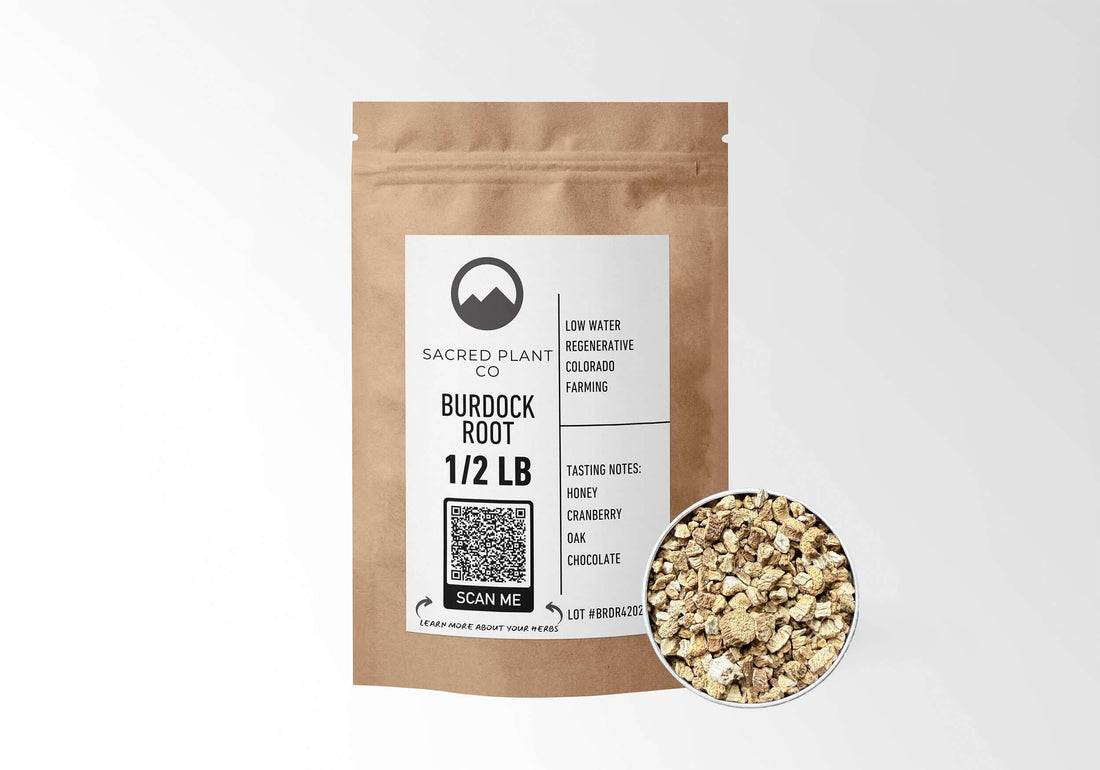
Premium burdock root exhibits a distinctive warm brown color with hints of honey and oak, maintains structural integrity that produces a clean snap rather than bend, and releases complex aromatic notes of subtle sweetness with earthy undertones. These sensory characteristics directly correlate with proper harvesting timing and post-harvest processing methods.
 Transparency in Hand: Scan the QR code to view the lab test results for your specific batch, verifying purity from heavy metals. Small-batch farming means we track every harvest, so you know exactly where your medicine comes from.
The Sensory Quality Check
Visual Assessment: Look for roots displaying rich, warm brown coloring with subtle variations ranging from honey-golden to deep oak tones. Avoid roots with gray, pallid, or excessively dark (nearly black) coloration, which indicate oxidation, improper drying, or extended storage under poor conditions. Premium cut and sifted burdock should show consistent sizing with minimal dust or fragmented material.
Textural Evaluation: Quality dried burdock root should produce a crisp snap when broken, not a fibrous bend. This snap indicates proper moisture content (typically 8-12%) and suggests the root retained its cellular integrity during drying. Roots that bend or feel rubbery often suffered from too-rapid drying at excessive temperatures, which can degrade delicate compounds.
Aromatic Profile: Fresh, properly stored burdock root releases subtle aromatic notes when crushed or steeped. You should detect hints of honey sweetness, gentle cranberry-like tartness, the grounding earthiness of oak, and surprisingly, delicate chocolate undertones. These complex tasting notes, honey, cranberry, oak, and chocolate, emerge from the diverse array of volatile compounds and polysaccharides present in roots grown in Indigenous Microorganism (IMO) rich soil. Roots lacking aroma or exhibiting musty, moldy, or sharply acrid scents should be avoided.
These sensory indicators connect directly to harvesting and processing practices. Burdock roots harvested after the first light frost develop enhanced sweetness as starches convert to sugars. Slow air-drying at temperatures below 110°F preserves volatile aromatic compounds and heat-sensitive constituents. Understanding these quality markers empowers you to make informed sourcing decisions.
Lab Test Results: Transparency in Every Batch
We believe you deserve to know exactly what's in your herbs. Every batch of our burdock root undergoes comprehensive laboratory testing for:
- Heavy metals (lead, arsenic, cadmium, mercury)
- Microbial contamination (E. coli, Salmonella, yeast, mold)
- Identity verification
- Foreign matter (visual and metal detection)
Request Lab Test Results by Lot # We publish the lab test results for every lot we test on our lab testing page.
Botanical Profile and Traditional Wisdom
Burdock root (Arctium lappa) is a biennial plant in the Asteraceae family, native to Europe and Asia, now naturalized throughout North America, traditionally valued across multiple healing systems for blood purification, liver support, and skin health.1
Botanically, burdock develops a substantial taproot during its first year of growth, storing nutrients and medicinal compounds in preparation for flowering in year two. This taproot, harvested in autumn of the first year or early spring of the second, can reach depths of three feet and diameters of several inches. The plant's large, heart-shaped leaves and distinctive burr-covered seed heads made it unmistakable to traditional herbalists across continents.
In Traditional Chinese Medicine, burdock root (niúbàng) has been used for over 3,000 years as a cooling herb that clears heat, removes toxins, and supports healthy skin. TCM practitioners categorize it as entering the Lung and Stomach meridians, making it particularly suited for conditions manifesting as inflammation, skin eruptions, or digestive stagnation.2
European folk medicine embraced burdock as a key component of "blood purifying" spring tonics, often combined with dandelion, nettle, and yellow dock. These traditional formulations align remarkably well with modern understanding of burdock's hepatoprotective and alterative properties. The famous Essiac formula, developed in Canada, featured burdock root as a primary ingredient.
Indigenous peoples of North America independently discovered burdock's medicinal properties after its introduction to the continent. Various tribes incorporated the root into poultices for wounds, decoctions for rheumatic conditions, and tonics for general debility. Because burdock's traditional uses span diverse healing systems and geographic regions, we honor this wisdom while acknowledging it represents traditional knowledge rather than medical claims.
The Science Behind Burdock's Medicinal Properties
Modern research has identified numerous bioactive compounds in burdock root, including arctiin, arctigenin, inulin (up to 45% by dry weight), polyacetylenes, flavonoids, and lignans, which demonstrate hepatoprotective, inflammatory response modulation, antioxidant, and prebiotic activities in scientific studies.3,4
A 2011 study published in the Journal of Biomedical Science examined arctigenin, one of burdock's primary lignans, finding it supported a healthy inflammatory response by modulating inflammatory mediators including TNF-α, IL-1β, and IL-6.5 These findings provide mechanistic support for burdock's traditional use in supporting the body's natural inflammatory pathways.
Research into burdock's hepatoprotective properties revealed promising results. A 2002 study in Journal of Agricultural and Food Chemistry demonstrated that burdock root extract protected liver cells from carbon tetrachloride-induced damage, suggesting potential applications in supporting liver health during toxic exposure.6 The researchers attributed this protective effect to burdock's antioxidant compounds, particularly caffeic acid derivatives and arctiin.
The prebiotic properties of burdock's high inulin content have attracted considerable scientific interest. Inulin, a fructooligosaccharide, selectively promotes the growth of beneficial Bifidobacteria and Lactobacilli in the gut microbiome. A 2015 study in Nutrients confirmed that dietary inulin supplementation significantly increased beneficial bacterial populations while supporting healthy immune function.7 This prebiotic activity may explain some of burdock's traditional "blood purifying" effects, as gut health profoundly influences systemic inflammation and toxin processing.
Burdock's effects on skin health have also been examined scientifically. A 2008 study published in Journal of Cosmetic Dermatology found that topical application of burdock extract improved signs of aging in mature skin, attributed to the root's antioxidant compounds and anti-inflammatory activity.8 While this research examined topical use, it supports the traditional practice of using burdock internally for skin conditions, given the known connection between internal inflammation and skin health.
Research continues to explore burdock's potential in metabolic support. A 2014 animal study in the International Journal of Biological Macromolecules demonstrated that burdock polysaccharides helped maintain healthy blood glucose levels in diabetic mice, possibly through enhancing insulin sensitivity and reducing hepatic glucose production.9 While animal models show promise for understanding metabolic mechanics, human clinical trials are necessary to confirm these specific glycemic effects. These preliminary findings should not be interpreted as evidence for diabetes treatment in humans.
It's important to note that while these studies provide compelling evidence for burdock's bioactive properties, they represent ongoing research into traditional uses rather than FDA-approved medical applications. We present this science to illuminate mechanisms behind traditional practices, not to make disease treatment claims.
Premium Burdock Root
Experience burdock root sourced with regenerative principles. Our cut and sifted burdock root delivers the complex aromatic profile and therapeutic compounds that develop only when roots interact with diverse soil biology throughout their growth cycle.
Shop Burdock RootTraditional Preparation Methods and Ritual
Burdock root is traditionally prepared as a decoction (simmered tea), tincture, or food vegetable, with decoction being the most common method requiring 1-2 teaspoons of dried root simmered in 8 ounces of water for 20-30 minutes.
 The Deep Earth Ritual: To access the deep mineral content of burdock, a simple steep isn't enough. A 20-minute simmer breaks down the hardy cellular structure of the root, pulling the grounding vitality of the soil into a warming, restorative tonic.
Classic Burdock Root Decoction
Ingredients:
- 1-2 teaspoons dried, cut and sifted burdock root
- 8-10 ounces pure water
- Optional: lemon, honey, or ginger to taste
Instructions:
- Place burdock root in a small saucepan with cold water
- Bring to a gentle boil, then reduce to a low simmer
- Cover and simmer for 20-30 minutes, allowing the water to reduce by about one-quarter
- Strain through a fine mesh strainer, pressing gently to extract remaining liquid
- Add optional flavorings if desired
- Drink warm, 1-3 cups daily
The Ritual Element: Traditional herbalists often speak of setting intention while preparing plant medicines. As you simmer your burdock decoction, consider the root's journey from deep in the earth, drawing nutrients and vitality from the soil, now transferring that concentrated earth energy into your cup. This mindful preparation transforms a simple tea into a sacred practice of connection with plant medicine.
Burdock Root Tincture: For alcohol-based extraction, use a 1:5 ratio of dried root to menstruum (typically 40-50% alcohol). Combine in a glass jar, shake daily, and strain after 4-6 weeks. Standard dosage is 2-4 ml (40-80 drops), 2-3 times daily.
Burdock as Food: Fresh burdock root, known as "gobo" in Japanese cuisine, can be peeled, sliced, and added to soups, stir-fries, or pickled preparations. This culinary use provides gentle, nourishing support and represents the food-as-medicine philosophy found in many traditional systems.
Combination Formulas: Burdock synergizes well with other detoxification and lymphatic herbs. Traditional pairings include dandelion root for enhanced liver support, red clover for lymphatic cleansing, and yellow dock for additional alterative properties. Because it pairs well with lymphatic system support, it combines effectively with red clover for deep tissue cleansing.
Dosage Guidelines and Administration
Decoction: 1-2 teaspoons (approximately 2-4 grams) simmered in water, consumed 2-3 times daily. This represents the traditional dosage range used in both European and Asian herbal medicine.
Tincture (1:5, 40-50% alcohol): 2-4 ml (40-80 drops), 2-3 times daily. Tinctures provide convenience and concentrated extraction of both water-soluble and alcohol-soluble constituents.
Duration: Burdock is generally used for 4-12 weeks in therapeutic protocols, though some traditional systems employ longer-term use. As with all herbs, it's wise to take periodic breaks and reassess your body's needs. For extended use beyond three months, consultation with a qualified herbalist or healthcare provider is recommended.
Timing: Burdock can be taken with or without food, though some people find it gentler on the stomach when consumed with meals. For detoxification purposes, some practitioners recommend taking it between meals to enhance its cleansing activity.
Safety Considerations and Contraindications
Important Safety Information
Contraindications:
- Pregnancy and Lactation: Burdock root is traditionally avoided during pregnancy due to its potential uterine stimulant properties. While evidence is limited, it's prudent to avoid therapeutic doses during pregnancy and breastfeeding unless under professional guidance.
- Allergies: Individuals with known allergies to plants in the Asteraceae/Compositae family (ragweed, chrysanthemums, marigolds, daisies) should approach burdock with caution, as cross-reactivity is possible.
- Bleeding Disorders: Burdock may have mild anticoagulant properties. Those with bleeding disorders or taking anticoagulant medications should consult healthcare providers before use.
- Diabetes Medications: Due to burdock's potential blood sugar-lowering effects, those taking diabetes medications should monitor blood glucose levels carefully and consult their healthcare provider, as dosage adjustments may be necessary.
- Upcoming Surgery: Discontinue burdock at least two weeks before scheduled surgery due to potential effects on blood clotting and blood sugar regulation.
Potential Interactions: Burdock may interact with diuretic medications, anticoagulants (warfarin, aspirin), and diabetes medications. Always inform your healthcare provider about all herbs and supplements you're taking.
Energetic Considerations: In traditional systems, burdock is considered cooling and drying. Those with constitutions already tending toward coldness or dryness may wish to balance burdock with warming, moistening herbs, or use smaller doses. This represents energetic herbalism rather than contraindication, but it's worth noting for constitutional support.
Quality Concerns: Burdock's deep taproot can accumulate contaminants from soil. This makes sourcing from clean growing environments and verified testing protocols essential. Always request lab test results showing heavy metal testing.
General Tolerance: Burdock root is generally well-tolerated with a strong safety profile established through centuries of traditional use. Side effects are rare but may include mild digestive upset in sensitive individuals, particularly when starting with higher doses. Begin with lower doses and gradually increase to assess individual tolerance.
Why Regenerative Sourcing Matters for Burdock Root
 The Bio-Accumulator Effect: Burdock's massive taproot acts as a mineral straw. This is why soil purity is non-negotiable—the root concentrates whatever it touches, good or bad. We hand-dig to preserve the nutrient-dense tip where the most potent medicine resides.
Burdock's status as a bioaccumulator makes regenerative, clean-soil sourcing practices critical, as the deep taproot absorbs and concentrates both beneficial nutrients and potential contaminants from the soil environment.
This bioaccumulator characteristic represents both burdock's medicinal power and potential vulnerability. When grown in healthy, uncontaminated soil, burdock concentrates beneficial minerals including potassium, iron, and trace elements. However, the same absorption capacity means roots grown in contaminated environments can accumulate heavy metals, agricultural chemical residues, and other undesirable compounds.
At our I·M·POSSIBLE Farm, harvesting burdock is an athletic event. We have to dig carefully around the 3-foot taproot in our living, Indigenous Microorganism (IMO) rich soil to ensure we don't snap the tip, where the highest concentration of minerals often resides. If a supplier sends you short, stubby chunks, they likely used industrial machinery that sacrificed the root's integrity for speed. That broken tip? It's not just cosmetic. It's lost medicine. This hands-on approach takes more time and labor, but it's the only way to preserve the complete therapeutic profile that nature intended.
Our commitment to regenerative practices and comprehensive testing addresses this concern directly. We prioritize sourcing from growing environments that have been verified for soil cleanliness and beneficial microbial activity. Every batch undergoes laboratory testing for microbial contaminants, heavy metals, and identity and foreign matter. This isn't just quality control; it's a fundamental responsibility when working with deep-rooted bioaccumulator plants.
The regenerative approach also influences burdock's therapeutic compound development through rhizosphere interactions. Research suggests that plants grown in Indigenous Microorganism (IMO) rich soil, abundant with mycorrhizal fungi and beneficial bacteria, produce higher concentrations of secondary metabolites including the lignans and polyacetylenes that give burdock its medicinal properties. These rhizosphere interactions, the complex communications between root systems and soil microbiota, directly influence the plant's production of defensive and therapeutic compounds. When we talk about regenerative herbalism, we're not just protecting the environment. We're producing functionally superior medicine.
Storing Your Burdock Root for Maximum Potency
Store dried burdock root in airtight containers away from light, heat, and moisture, maintaining optimal quality for 1-2 years when properly stored.
Proper storage preserves burdock's aromatic compounds, prevents oxidation of delicate constituents, and protects against moisture absorption that can lead to mold. Use glass jars with tight-fitting lids or high-quality resealable bags, storing in a cool, dark location like a pantry or cupboard. Avoid storing near the stove or in direct sunlight.
Label containers with the purchase date to track freshness. While dried burdock can remain safe to consume for extended periods, therapeutic potency gradually declines over time. For optimal results, use within one year of purchase.
For comprehensive guidance on bulk herb storage and maintaining potency, see our detailed guide: How to Buy, Store, and Use Herbs in Bulk.
Explore Related Herbal Wisdom
Burdock root's detoxification and liver support properties complement several other herbs in our collection. Explore these related articles to deepen your understanding:
- Burdock Root vs. Dandelion: Which Detox Herb Reigns Supreme? – Compare these two powerful liver-supporting roots and learn when to use each for optimal cleansing and vitality.
- Top 10 Health Benefits of Dandelion Root – Because burdock and dandelion both support liver function through different mechanisms, they're often combined in traditional detoxification protocols for synergistic effects.
- Top 10 Health Benefits of Burdock Root: Nature's Detox Superfood – Dive deeper into the specific health applications and traditional uses of this remarkable root.
Frequently Asked Questions About Burdock Root
Conclusion: Your Partner in Quality Burdock Root
Your search for "where to buy burdock root" has led you to a deeper understanding of what quality truly means in herbal medicine. It's not just about finding a supplier; it's about discovering a partner who shares your values around sustainability, transparency, and the recognition that soil health directly translates to medicinal potency.
At Sacred Plant Co, we approach burdock root through the lens of regenerative herbalism, understanding that this deep-rooted bioaccumulator requires clean soil, diverse microbial activity, and careful processing to reach its full therapeutic potential. From the complex aromatic profile of honey, cranberry, oak, and chocolate to the scientifically validated compounds like arctiin and inulin, quality burdock root represents the intersection of traditional wisdom and modern verification.
Whether you're seeking liver support, exploring traditional detoxification practices, or simply incorporating nourishing food herbs into your wellness routine, the quality of your source material fundamentally shapes your results. We invite you to experience the difference that regenerative practices, comprehensive testing, and mindful processing make in every cup of burdock tea.
Your journey toward natural health and sustainability deserves a partner who understands that the best medicine grows from the healthiest soil.
References
- Chan YS, Cheng LN, Wu JH, et al. A review of the pharmacological effects of Arctium lappa (burdock). Inflammopharmacology. 2011;19(5):245-254. doi:10.1007/s10787-010-0062-4
- Tierra M. The Way of Herbs. New York, NY: Pocket Books; 1998.
- Ferracane R, Graziani G, Gallo M, Fogliano V, Ritieni A. Metabolic profile of the bioactive compounds of burdock (Arctium lappa) seeds, roots and leaves. J Pharm Biomed Anal. 2010;51(2):399-404. doi:10.1016/j.jpba.2009.03.018
- Lin SC, Lin CH, Lin CC, et al. Hepatoprotective effects of Arctium lappa Linne on liver injuries induced by chronic ethanol consumption and potentiated by carbon tetrachloride. J Biomed Sci. 2002;9(5):401-409. doi:10.1007/BF02256538
- Zhao F, Wang L, Liu K. In vitro anti-inflammatory effects of arctigenin, a lignan from Arctium lappa L., through inhibition of iNOS pathway. J Ethnopharmacol. 2009;122(3):457-462. doi:10.1016/j.jep.2009.01.038
- Lin CC, Lu JM, Yang JJ, Chuang SC, Ujiie T. Anti-inflammatory and radical scavenge effects of Arctium lappa. Am J Chin Med. 1996;24(2):127-137. doi:10.1142/S0192415X96000177
- Slavin J. Fiber and prebiotics: mechanisms and health benefits. Nutrients. 2013;5(4):1417-1435. doi:10.3390/nu5041417
- Knott A, Reuschlein K, Mielke H, et al. Natural Arctium lappa fruit extract improves the clinical signs of aging skin. J Cosmet Dermatol. 2008;7(4):281-289. doi:10.1111/j.1473-2165.2008.00407.x
- Cao H, Ou J, Chen L, et al. Dietary polyphenols and type 2 diabetes: Human Study and Clinical Trial. Crit Rev Food Sci Nutr. 2019;59(20):3371-3379. doi:10.1080/10408398.2018.1492900
- Hoffmann D. Medical Herbalism: The Science and Practice of Herbal Medicine. Rochester, VT: Healing Arts Press; 2003.
- Mills S, Bone K. Principles and Practice of Phytotherapy: Modern Herbal Medicine. 2nd ed. Edinburgh: Churchill Livingstone; 2013.
- Grieve M. A Modern Herbal. New York, NY: Dover Publications; 1971.


