


Last Updated: July 30, 2026

Crush a dried Yerba Santa leaf between your fingers and the first thing that hits you is aroma. Resinous, balsamic, part pine and part eucalyptus, it announces itself before it ever touches water. That intensity is not decoration. It is chemistry, and at Sacred Plant Co we treat it as the first quality signal any respiratory herb should give you. A lack of aroma equals a lack of medicine. Real medicine should shock the senses, and if a leaf does not bite back, it is not working.
Yerba Santa, or "Holy Herb" in Spanish, has carried that resinous potency through centuries of use across the chaparral of California and Oregon. The resin is where the volatile oils, flavonoids, and diterpenic acids live, and the concentration of those compounds is a direct readout of the conditions the plant grew in. This is the heart of our Soil-to-Potency Thesis: microbial diversity in living soil directly increases the secondary metabolite production that makes an aromatic herb like this one worth reaching for.
That is why we approach every botanical, whether wild harvested or cultivated, through the lens of regenerative thinking and rigorous testing rather than commodity sourcing. Below you will find the botanical profile, the traditional record, the research, preparation methods, safety guidance, and the full lab test results for our current lot. To see the soil science that anchors our standard, start with how we achieved a 400% increase in soil biology in a single season.
What You'll Learn in This Guide
- How to identify premium Yerba Santa by color, resin, texture, and aroma before you brew it
- The botanical profile and documented traditional uses across California Indigenous cultures
- Which compounds drive the expectorant and bronchial actions, and what the research shows
- Traditional preparation methods, including tea, tincture, steam, and ceremonial smoke
- A therapeutic respiratory relief tea recipe pairing Yerba Santa with American Ginseng and Chaga
- Detailed dosage ranges by preparation, plus contraindications and drug interactions
- The exact lab test results for our current lot, read straight from the lab test results
- How soil biology and regenerative sourcing translate into measurable medicinal potency
- How to store dried leaf and tinctures to preserve aromatic compounds over time
Key Takeaways
- Yerba Santa (Eriodictyon californicum) is an aromatic evergreen shrub of the waterleaf family whose resinous leaves have been used by California Indigenous nations primarily for coughs, colds, and bronchial congestion.
- Its expectorant action is attributed to flavonoids such as eriodictyol and homoeriodictyol plus eucalyptol-rich volatile oils that help thin and mobilize mucus.
- Sacred Plant Co lot YERB-6849 was laboratory tested on 10.13.2025 and returned lead at 0.5 ppm, arsenic at 0.13 ppm, Salmonella negative per 25 g, and E. coli negative, with a full report published below.
- A standard dried-leaf tea uses 1 to 2 teaspoons of crushed leaf per 8 ounces of water; a standard adult tincture dose is 30 to 60 drops taken 2 to 3 times daily.
- Yerba Santa is not recommended during pregnancy or nursing, or for children under 6, without qualified professional guidance.
- Living-soil sourcing matters because plants grown in biologically rich soil produce higher concentrations of the secondary metabolites responsible for medicinal activity.
Yerba Santa By the Numbers
| Latin Name | Eriodictyon californicum |
|---|---|
| Family | Waterleaf family (Hydrophyllaceae / Namaceae) |
| Parts Used | Leaf (whole, dried) |
| Primary Active Compounds | Flavonoids (eriodictyol, homoeriodictyol, eriodictyol glycosides), diterpenic acids, eucalyptol and volatile terpenes |
| Traditional Energetics | Warming, drying, aromatic, resinous |
| Native Range | Coastal mountains and foothills of California and Oregon |
| Plant Type | Aromatic evergreen shrub, 3 to 6 feet tall |
| Leaf Size | Individual leaves 5 to 15 cm in length |
| Caffeine Status | Caffeine-Free |
| Sacred Plant Co Lab Test Results | Available per lot. Latest lot YERB-6849 (tested 10.13.2025): lead 0.5 ppm, Salmonella negative per 25 g. Full results in the lab-results table below. |
What Is Yerba Santa and Why Is It Called the Sacred Herb?
Yerba Santa is an aromatic, resin-coated evergreen shrub native to California and Oregon whose leaves have been used for generations as a respiratory and expectorant medicine, earning the Spanish name "Holy Herb." The plant's reputation rests on a simple observation that Indigenous herbalists made long before laboratory analysis existed: the more resinous and aromatic the leaf, the more it seemed to do.
That resin is the defining feature. It protects the plant against moisture loss and herbivory in a dry climate, and in doing so it concentrates the volatile oils and flavonoids responsible for the herb's medicinal reputation. Understanding why that concentration varies from batch to batch is where our growing philosophy comes in.
How to Identify Premium Yerba Santa
Premium Yerba Santa is recognizable by olive-green to dark-green leaves, a sticky resin coating, a silvery underside, and a powerful resinous-balsamic aroma with notes of pine and eucalyptus. The sensory check matters because aroma and resin are the visible proxies for the active compounds you are actually buying.
Sensory Quality Check for Yerba Santa Leaf
Color: Olive green to dark green, sometimes slightly brownish when dried, with a paler, sometimes silvery-haired underside. Dull, gray, or faded leaf suggests age or poor drying.
Texture: The leaf surface should feel tacky and resinous rather than papery. That stickiness is the resin that carries the volatile oils.
Aroma: Immediately resinous and balsamic, with clear pine or eucalyptus lift. A strong, almost sharp fragrance is the signal you want. Weak aroma means weak medicine.
Taste: Characteristically sweet and resinous up front, followed by a lingering, gentle bitterness. The initial sweetness is attributed to eriodictyol glycosides in the leaf.
Drying method: Look for whole, intact dried leaf rather than crumbled dust. Careful low-heat drying preserves the resin and the aromatic terpenes that heat and time strip away.
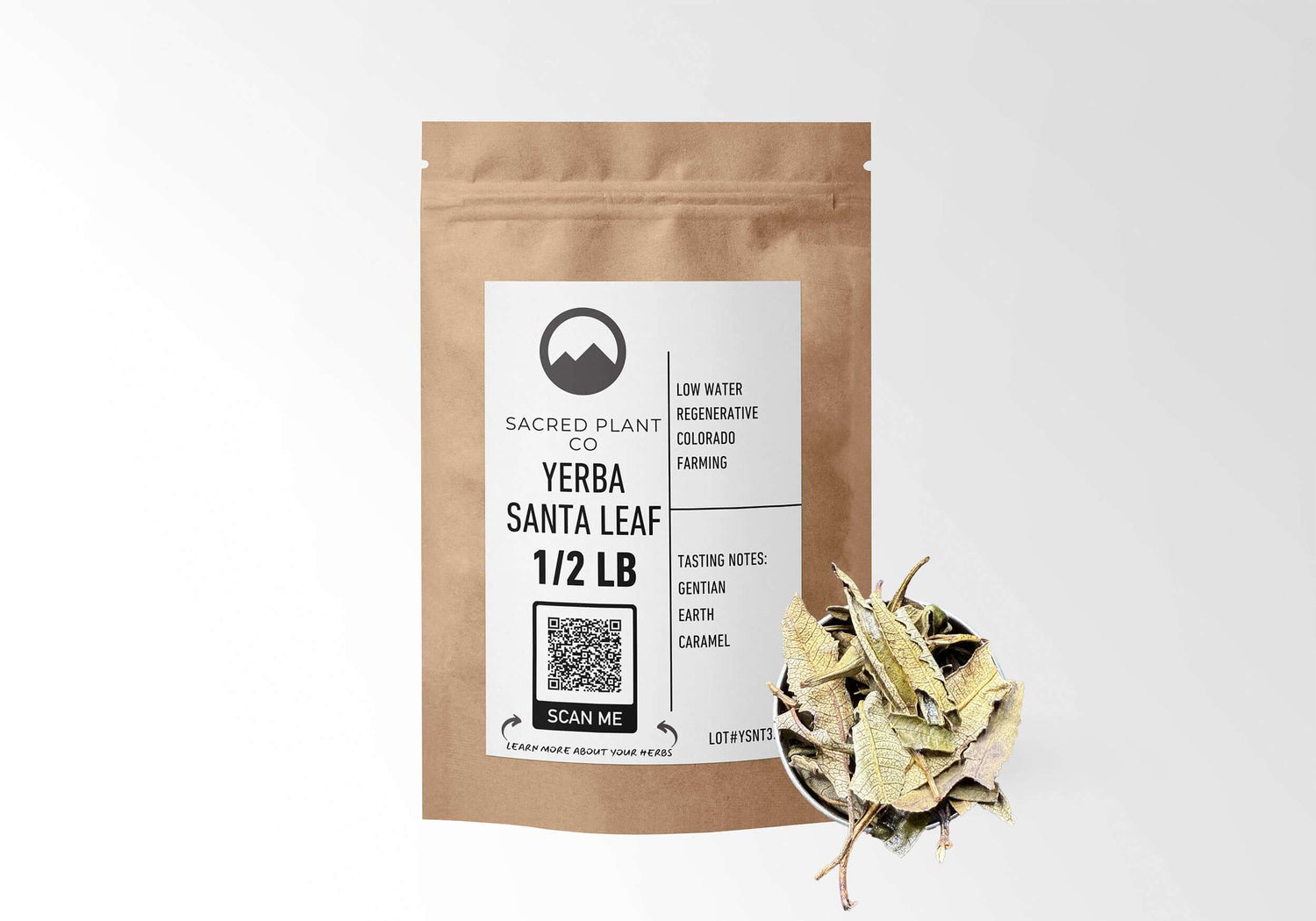
Yerba Santa Leaf
Starting at $10.99
Tasting Notes: Gentian, Earth, Caramel
Caffeine-FreePremium Yerba Santa leaf, selected for its resinous quality and aromatic intensity. Traditionally used for respiratory support and ceremonial practice, and laboratory tested before release.
Shop Yerba SantaBotanical Profile and Traditional Significance
Yerba Santa belongs to the waterleaf family and grows as a 3-to-6-foot aromatic shrub whose lance-shaped, resin-glossed leaves were valued as a respiratory medicine by the Chumash, Miwok, Yokuts, and Pomo peoples. The plant's traditional record is unusually consistent across nations, pointing again and again to the lungs and airways.
The resinous coating serves multiple ecological functions, from protecting against moisture loss to defending against herbivory, and it concentrates many of the plant's active compounds. Indigenous peoples of California valued Yerba Santa as a sacred medicine long before European contact, with dried leaves smoked or brewed as tea to address coughs, colds, asthma, and bronchial congestion.1 The Chumash people also applied poultices of the crushed leaves to reduce swelling and aid wound healing, while the Yokuts incorporated it into ceremonial and purification practices.2
Chemical Constituents and Therapeutic Properties
The medicinal properties of Yerba Santa derive from a complex mixture of bioactive compounds concentrated in its resinous leaves. Primary constituents include flavonoids (eriodictyol, homoeriodictyol, eriodictyol glycosides), diterpenic acids, phenolic compounds, and volatile oils rich in eucalyptol and related terpenes.3 This phytochemical profile accounts for the herb's pronounced expectorant, bronchial, and antimicrobial character.
Flavonoids in Yerba Santa demonstrate antioxidant activity and have been shown in laboratory studies to reduce inflammation in respiratory tissues.3 The eucalyptol content provides the characteristic aroma while contributing to mucus-thinning effects, making expectoration easier during respiratory congestion. These compounds appear to work together, which helps explain why traditional whole-herb preparations are often favored over isolated constituents.
Scientific Research on Respiratory Health Benefits
Modern research supports the traditional use of Yerba Santa as an expectorant, with studies indicating that its compounds reduce the viscosity of mucus so it can be cleared more easily from the airways. The evidence base is still developing, but it aligns closely with centuries of documented use.
Studies on the expectorant properties demonstrate that compounds in the leaves help thin respiratory mucus, facilitating its expulsion from the respiratory tract.4 This action is especially relevant during colds, bronchitis, and other conditions characterized by productive coughs with thick phlegm. Reviews of Eriodictyon flavonoids also describe bronchial-relaxing effects that may offer supportive relief for mild respiratory complaints.5
The antimicrobial properties of Yerba Santa have also attracted scientific attention. Laboratory studies demonstrate activity against various microorganisms, and broader research on plant flavonoids documents their capacity to disrupt microbial cell membranes.6 Human clinical trials remain limited, so these findings are best understood as mechanistic support for traditional use rather than proof of a specific outcome.
Traditional Preparation and Ritual
Yerba Santa Tea for Daily Respiratory Support

The most accessible way to work with Yerba Santa is as a tea, using 1 to 2 teaspoons of dried, crushed leaf per 8 ounces of hot water, steeped covered for 10 to 15 minutes. Pour just-boiled water over the herb and keep it covered to trap the volatile oils. The resulting tea is distinctly aromatic and slightly bitter, with resinous, balsam-like undertones.
Adding honey improves palatability while contributing its own soothing quality. This is where the word "Sacred" earns its place in our name: preparing the tea slowly, covered, and with intention treats the plant as a partner rather than a commodity.
Tincture Preparation and Dosing
Alcohol tinctures concentrate Yerba Santa's resinous compounds, with a standard adult dose of 30 to 60 drops (roughly 1.5 to 3 ml) taken 2 to 3 times daily, diluted in water or tea. To make one, fill a jar with dried leaf, cover with 80-proof or higher alcohol, and macerate for 4 to 6 weeks, shaking daily, then strain and bottle with the date and herb name.
Ceremonial Smoke and Space Clearing

Beyond internal preparations, Yerba Santa holds a place in ceremonial practice. The dried leaves, bundled or burned loose on charcoal, produce an aromatic smoke used for purification, prayer, and space clearing.7 This is a widespread traditional use of aromatic plants for creating sacred space, distinct from closed Indigenous ceremonies.
The smoke-cleansing tradition with Yerba Santa focuses on clearing stagnant energy and supporting focus and reflection. When engaging with it, source the herb respectfully and understand the difference between universal smoke-cleansing practices, which exist in many cultures, and specific Indigenous ceremonies that should not be appropriated. If you prefer to avoid smoke entirely, steam inhalation from a covered pot of the hot tea delivers the aromatic compounds to the airways without combustion.
Therapeutic Yerba Santa Respiratory Relief Tea
Ingredients:
- Yerba Santa leaves (dried) – 2 teaspoons
- American Ginseng root (dried, sliced) – 1 tablespoon
- Wild Chaga (dried chunks) – 1 tablespoon
- Raw honey – 1 to 2 teaspoons (optional)
- Fresh lemon juice – 1 teaspoon (optional)
- Filtered water – 10 ounces
Preparation Instructions:
- Prepare Ingredients: Lightly crush the Yerba Santa leaves to release the aromatic oils. If using whole Chaga chunks, break them into smaller pieces for better extraction.
- Combine Herbs: Place the Yerba Santa, American Ginseng, and Chaga in a small pot with the filtered water.
- Simmer Gently: Bring to a gentle boil, then reduce the heat and simmer, covered, for 15 to 20 minutes. This extended time helps draw out the compounds from all three herbs.
- Strain and Serve: Remove from heat, strain into your favorite mug, and add honey and lemon if desired.
- Consumption Notes: Drink while warm. This tea can be enjoyed 1 to 3 times daily.
Why These Herbs Work Together:
Yerba Santa acts as the primary expectorant, helping clear congestion. American Ginseng contributes adaptogenic support for the body's stress response, and Wild Chaga adds antioxidants and beta-glucans that support overall resilience. Together they create a preparation more rounded than any single herb.
A note from Patrick: The first time I simmered this blend I was surprised how the Chaga rounds off Yerba Santa's resinous edge. On its own the leaf can taste almost sharp, but after a slow twenty-minute simmer it turns warm and faintly sweet, and a spoon of honey pulls the whole cup together. I keep the lid on the pot the entire time so I catch that first hit of pine and balsam the moment I pour.
Dosage Guidelines and Safety Considerations
Recommended Dosages by Form
For dried-leaf tea, adults can use 1 to 2 teaspoons of herb per 8-ounce cup, 2 to 3 cups daily. Amounts depend on the preparation, so start conservatively and adjust.
When working with tinctures, standard adult dosing ranges from 30 to 60 drops (1.5 to 3 ml) taken 2 to 3 times daily. For children over 12, reduce adult doses by half. For children ages 6 to 12, consult a qualified herbalist or healthcare provider for appropriate dosing based on weight and individual factors. Yerba Santa is generally not recommended for children under 6 without professional guidance.
Safety, Contraindications, and Drug Interactions
Important Safety Information
Pregnancy and Nursing: Due to limited safety data, pregnant and nursing women should avoid Yerba Santa except under the guidance of a qualified healthcare provider experienced in herbal medicine.
Kidney Conditions: Individuals with kidney disease or impaired kidney function should use caution, as limited information suggests possible effects with long-term high-dose use. Consult a qualified provider before use if you have kidney concerns.
Medication Interactions: If you take prescription medications, particularly bronchodilators, corticosteroids, or immunosuppressants, consult your healthcare provider before adding Yerba Santa to your routine.
Allergic Reactions: While rare, some individuals may react to Yerba Santa, particularly those sensitive to plants in the waterleaf family. Discontinue use and seek medical attention if you experience rash, difficulty breathing, or swelling.
Quality and Source: Always source Yerba Santa from suppliers who can document their testing for contaminants. Wild-harvested herbs carry risks of misidentification or contamination when not properly sourced and verified.
Regenerative Sourcing and Soil Health
At Sacred Plant Co, our approach to herbalism traces medicinal potency back to soil biology, which guides both our practices at I·M·POSSIBLE Farm and how we evaluate every botanical we bring in. Regenerative agriculture builds soil life through composting, cover cropping, and Korean Natural Farming inputs, creating the conditions in which plants express their full spectrum of beneficial compounds.
Research increasingly shows that plants grown in biologically rich soils produce higher concentrations of secondary metabolites, the very compounds that provide medicinal activity.8 This connection between soil microbiome diversity and plant chemistry is the reason we hold our benchmark Haney soil-health score of 25.4, a figure that exceeds the reading of an undisturbed native forest.9 For an aromatic species like Yerba Santa, which we source rather than cultivate, that same standard drives us toward material harvested from healthy, biodiverse ecosystems and verified by laboratory testing.
Storing and Preserving Yerba Santa
Store dried Yerba Santa in airtight glass containers away from light and heat, where it holds its aromatic potency for 1 to 2 years. A cool, dark pantry or cupboard works well, and the resinous nature of the leaf helps preserve its active compounds longer than many other herbs.
Moisture is the primary threat to quality, since it can lead to mold and degradation. In a humid climate, consider a food-safe desiccant packet in the container or refrigerating a well-sealed jar. For tinctures, store in amber glass away from light, where properly prepared alcohol extracts remain stable for 5 years or longer. For a deeper method, see our guide on how to buy, store, and use herbs in bulk.
Quality Assurance: Lab Test Results for Yerba Santa
Every batch of Yerba Santa we sell is laboratory tested before release for microbial safety, heavy metals, and foreign matter, and we publish the results for each lot below with the full lab test results linked. New to reading a lab report? Start with our guide on how to read lab test results.
Lot YERB-6849 (tested 10.13.2025, retest due 10.13.2028)
| Test | Method | Result | Release Limit | Status |
|---|---|---|---|---|
| Microbial | ||||
| Total Plate Count | Petrifilm AOAC 990.12 | 160 CFU/g | Report only | Pass |
| Yeast | Petrifilm AOAC 2014.05 | 150 CFU/g | Report only | Pass |
| Mold | Petrifilm AOAC 2014.05 | 900 CFU/g | Report only | Pass |
| Total Coliform | Petrifilm AOAC 991.14 | <10 CFU/g | Report only | Pass |
| E. Coli | Petrifilm AOAC 991.14 | Negative | Report only | Pass |
| Salmonella | BAX PCR AOAC 2013.02 | Negative/25g | Report only | Pass |
| Heavy Metals | ||||
| Arsenic | AOAC 2015.01 (#C55) | 0.13 ppm | Report only | Pass |
| Cadmium | AOAC 2015.01 (#C55) | 0.17 ppm | Report only | Pass |
| Lead | AOAC 2015.01 (#C55) | 0.5 ppm | Report only | Pass |
| Mercury | AOAC 2015.01 (#C55) | Not Detected | Report only | Pass |
| Foreign Matter | ||||
| Foreign matter | Visual and metal detection | Pass | <2.0% by weight | Pass |
Material: Yerba santa leaf, whole, wild crafted (Eriodictyon californicum). Sterilization method: Not Treated. Certified Kosher. Release limits on this lot's report are recorded as report only, and results are presented exactly as printed. No pesticides were used to grow this product, and it contains no additives, preservatives, solvents, or excipients. View the full lab test results for lot YERB-6849 (PDF). We publish the lab test results for every lot we test on our lab testing page.
New Harvest Alerts
Our herbs are released in small, lab-tested lots as each fresh harvest comes in. Get notified the moment a new batch of Yerba Santa is available so you can order at peak potency.
Sign Up for Harvest AlertsFrequently Asked Questions About Yerba Santa
Yerba Santa tastes characteristically sweet and resinous up front, followed by a lingering, gentle bitterness, with balsamic pine and eucalyptus notes throughout. The early sweetness is attributed to eriodictyol glycosides in the leaf. As the infusion settles, subtle caramelized undertones emerge and soften the sharper resinous edge. For newcomers, a touch of honey or a blend with complementary herbs creates a more approachable cup without dulling its character.
Tasting Notes: Gentian, Earth, Caramel.
Continue Your Herbal Education
- Yerba Santa: The Sacred Herb for the spiritual and cultural story that sits alongside this respiratory focus.
- Unlocking the Sacred Power of Yerba Santa to go deeper on ceremonial applications and ritual practice.
- Herbs for Phlegm: TCM and Western Herbs That Clear Mucus to place Yerba Santa within the wider family of expectorants.
- Breathe Better: The Best Herbal Tinctures for Lung Health if you would rather dose by dropper than by the cup.
- Allergy Relief Naturally: Herbal Tinctures for Seasonal Symptoms for the times congestion is driven by pollen rather than a cold.
- Soothe Your Cough Naturally for a broader survey of herbs that calm an irritated cough.
- Breathe Easy: Powerful Herbs to Support Lung Health to build a fuller respiratory apothecary around this leaf.
- Breathe Freely: Herbal Solutions for Cleansing the Lungs for a companion approach to airway support.
- Coltsfoot: The Cough Remedy of the Wild for another traditional cough herb to weigh against Yerba Santa.
- Thyme vs. Osha Root for a side-by-side look at two more airway allies.
- The Rituals Behind Smokable Herbs to understand responsible use before you burn any leaf.
- How to Read Lab Test Results to interpret the lab table above with confidence.
Conclusion: Honoring Tradition While Building Regenerative Futures
Yerba Santa stands as a bridge between generations of Indigenous respiratory wisdom and the standards of modern, lab-verified herbalism. As we work with this resinous plant, we are called to honor its cultural significance, source it responsibly, and integrate it thoughtfully into wellness practices that respect both human health and ecological integrity.
At Sacred Plant Co, our vision extends beyond simply offering quality herbs. We are committed to regenerative practices that build soil, support biodiversity, and preserve traditional knowledge. When you choose to work with Yerba Santa, you participate in a lineage of plant-based practice that spans centuries, backed by the transparency of published lab test results. Approach the plant with gratitude, respect its potency, and let its aromatic tea remind you of the connection between soil health, plant vitality, and human flourishing.
References
- Moerman, D. E. (1998). Native American Ethnobotany. Timber Press, Portland, Oregon.
- Timbrook, J. (2007). Chumash Ethnobotany: Plant Knowledge Among the Chumash People of Southern California. Heyday Books, Berkeley, California.
- Cushnie, T. P., & Lamb, A. J. (2005). Antimicrobial activity of flavonoids. International Journal of Antimicrobial Agents, 26(5), 343-356.
- Wichtl, M. (2004). Herbal Drugs and Phytopharmaceuticals: A Handbook for Practice on a Scientific Basis. CRC Press.
- Duke, J. A. (2002). Handbook of Medicinal Herbs (2nd ed.). CRC Press, Boca Raton, Florida.
- Cowan, M. M. (1999). Plant products as antimicrobial agents. Clinical Microbiology Reviews, 12(4), 564-582.
- Bear, S., & Bear, W. (1996). The Medicine Wheel: Earth Astrology. Fireside Books.
- Heinmann, K., et al. (2020). Soil health influences secondary metabolite production in medicinal plants. Journal of Applied Ecology, 57(8), 1582-1594.
- Sacred Plant Co. The Science Behind Sacred Plant Co's Soil Regeneration: Haney Score 25.4 Surpasses Pristine Forest.
- Sacred Plant Co. Beyond Organic: How Sacred Plant Co Achieved a 400% Soil Biology Increase in One Season.


